Português
 English
 Español
 عربي
عربي 한국어
한국어

Reviewing terrazzo stone samples before mass production is not only about choosing the most attractive color. A sample approval should help project buyers confirm whether the material direction, chip size, surface finish, thickness, application suitability, and acceptable variation are clear enough for production. If the sample is approved too casually, the real problem often appears later — when full slabs, cut-to-size pieces, or installed areas do not match the buyer’s expectation.
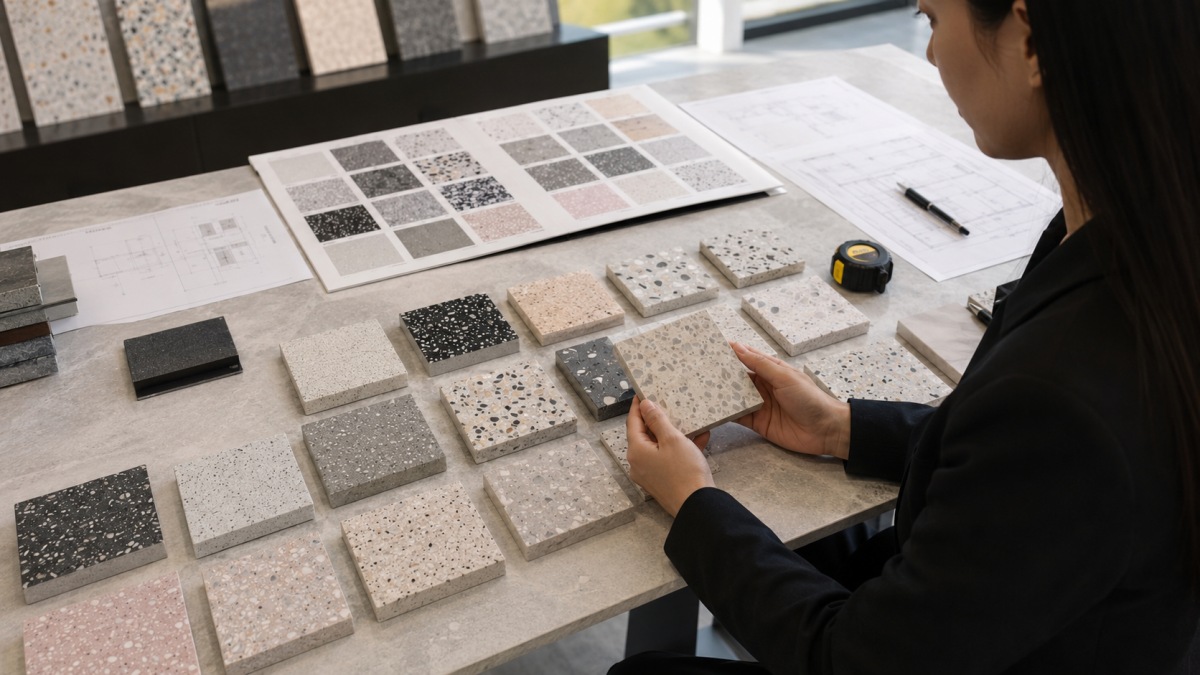
A terrazzo sample is not just a color reference. It is the buyer’s first control point before mass production.
For hotel lobbies, retail interiors, commercial flooring, wall panels, staircases, countertops, and other project applications, sample review should be treated as a decision process. The goal is not to find a perfect sample under perfect light. The goal is to define what can be approved, what still needs confirmation, and what cannot be judged from a small sample alone.
Why Terrazzo Sample Review Matters Before Production
Terrazzo has a strong visual character because it combines matrix color, stone chips, glass chips, marble aggregates, shell particles, or other decorative elements depending on the material design. The final appearance is affected by chip size, chip density, surface finish, polishing level, slab scale, lighting, and production batch.
This means a small sample can be useful, but it also has limits.
A buyer may approve a 100 x 100 mm or 150 x 150 mm sample and later find that the full slab looks more active, more sparse, more crowded, lighter, darker, or visually different when installed across a large area. This does not always mean the material is wrong. Sometimes it means the approval standard was not clear enough.
Sample review should reduce misunderstanding before production, not create disputes after production.
What a Terrazzo Sample Can Confirm
A terrazzo sample can help buyers confirm several important design and material directions.
It can usually help review:
· General matrix color direction
· Main chip colors
· Chip size category
· Approximate chip density
· Overall design character
· Surface finish direction
· Basic texture and touch
· Visual compatibility with other materials
· Whether the material fits the design mood
For example, a sample can help the designer decide whether the terrazzo feels calm, bold, minimal, warm, cool, dense, or decorative. It can also help the buyer compare terrazzo with surrounding materials such as marble, limestone, wood, metal, glass, or wall finishes.
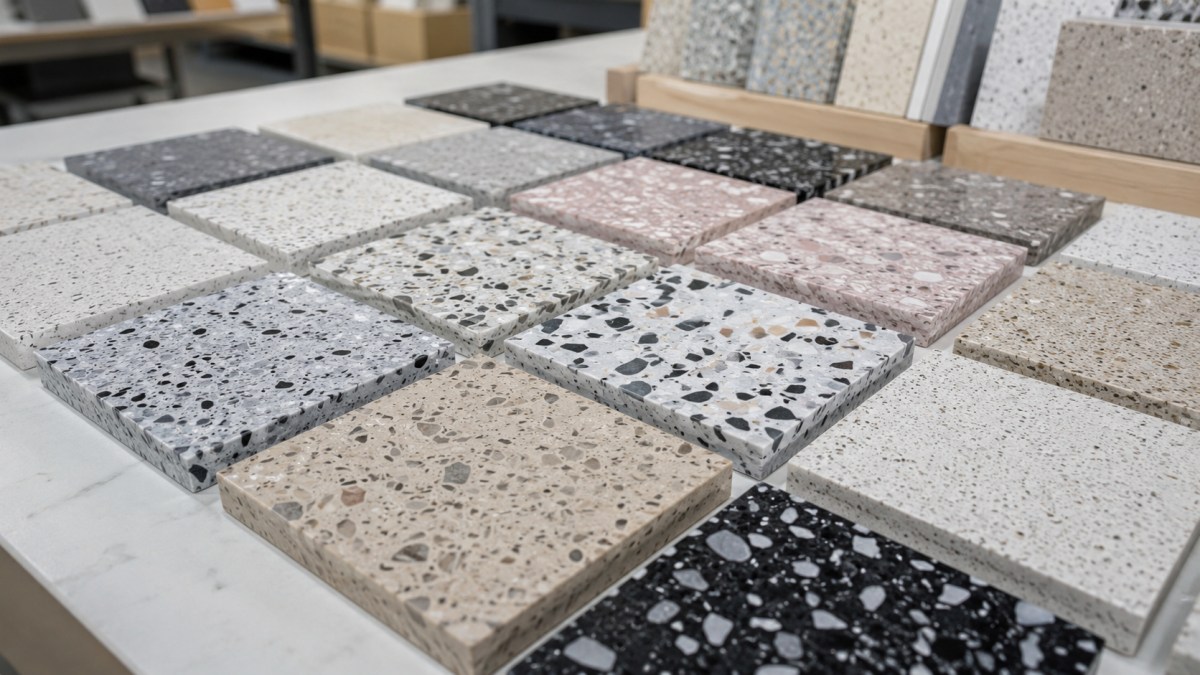
However, sample approval should not stop at “the color looks good.” Buyers should also ask whether the sample represents the production standard, the finish standard, the chip distribution direction, or only a general design reference.
What a Terrazzo Sample Cannot Fully Prove
This is where many project misunderstandings begin.
A small terrazzo sample cannot fully prove:
· Full slab chip distribution
· Large-area visual rhythm
· Batch-to-batch variation
· Final appearance under project lighting
· Complete floor or wall effect after installation
· Consistency between multiple slabs
· Full performance in every application
· Long-term maintenance behavior
· Exact visual result after cutting and edge finishing
A sample can guide approval, but it should not be treated as a promise that every part of every slab will look exactly the same. Terrazzo is a composite material with visible aggregates, and some level of visual variation is part of the material character.
For design-sensitive projects, especially large floors, hotel lobbies, commercial corridors, feature walls, or high-visibility countertops, buyers may need more than one sample. They may also need full slab photos, production mockups, or dry lay photos before final approval.
Review Matrix Color Carefully
The matrix color is the background tone of the terrazzo. It has a major influence on the final appearance.
Buyers should review:
· Is the matrix color warm, cool, neutral, grey, white, beige, black, green, red, or custom?
· Does it match the design intent?
· Does it coordinate with other project materials?
· Does it look different under natural daylight and interior lighting?
· Is the color range acceptable for the project?
· Is the approved sample a strict control sample or a general reference?
A matrix color that looks soft on a small sample may appear much stronger across a full floor. A white or light terrazzo may look clean and architectural, but it may also show dirt, stains, or maintenance issues more clearly depending on the application. A dark terrazzo may look dramatic, but it may show dust, scratches, or reflection differently.
The right question is not only “Do we like the color?” The better question is: “Will this matrix color still work when it covers the actual project area?”
Review Chip Size, Chip Color, and Chip Density
Chip size and distribution strongly affect how terrazzo appears at slab scale.
Buyers should confirm:
· Are the chips small, medium, large, or mixed?
· Are the chip colors consistent with the design direction?
· Is the chip density too sparse, too crowded, or balanced?
· Are large chips distributed naturally?
· Does the sample show enough of the visual character?
· Is the buyer expecting calm movement or strong decorative impact?
· Is the chip size suitable for the intended slab size or cut-to-size pieces?
Large chips can create a strong visual statement, but they may look uneven if judged only from a small piece. Small chips can create a softer and more uniform surface, but they may feel too plain for some design concepts.
For large-area projects, chip distribution should be reviewed with caution. A small sample may not show how the material behaves across full slabs or multiple panels.
Review the Finish Under Realistic Lighting
The surface finish should be reviewed before production, not after the material is finished.
Common terrazzo finishes may include:
· Polished
· Honed
· Matte
· Brushed
· Textured finish, depending on material and production capability
Finish affects appearance, reflection, cleaning, slip behavior, maintenance, and the user’s long-term experience.
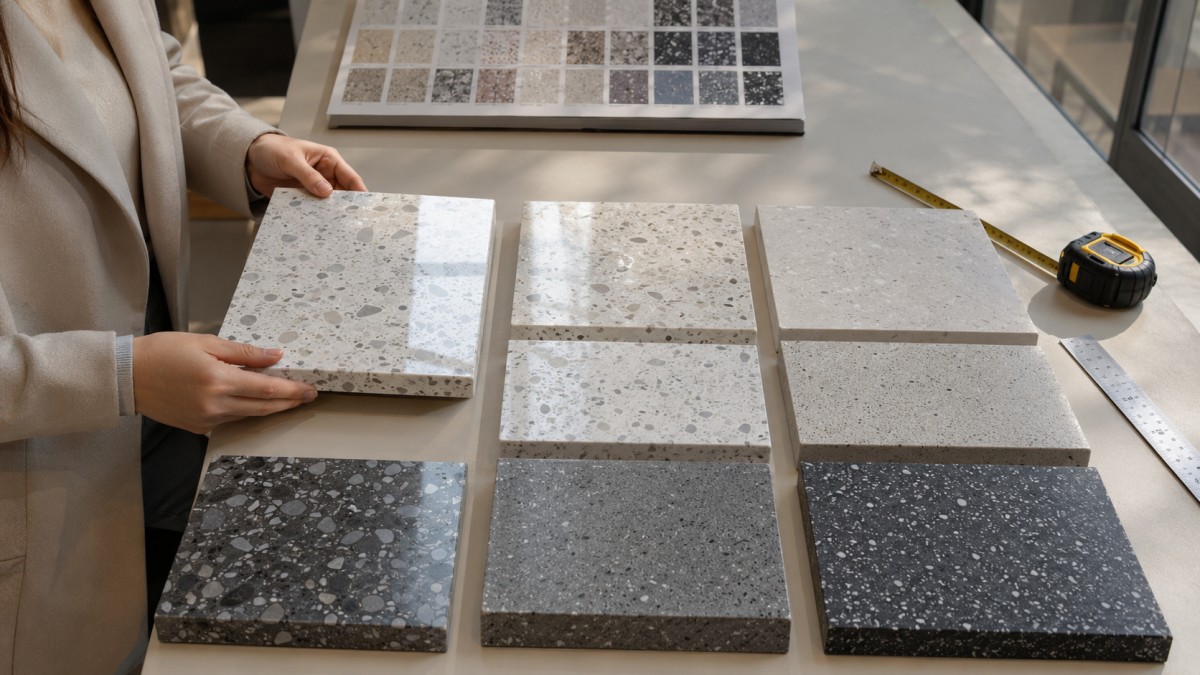
Buyers should check samples under conditions close to the real project environment:
· Natural daylight
· Warm interior lighting
· Strong commercial lighting
· Side lighting
· Dry condition
· Wet or semi-wet condition if relevant
· Lighting similar to the final installation area
Finish should be reviewed under the lighting condition closest to the final project, not only under showroom lights.
A polished sample may look more vivid and reflective. A honed or matte sample may look softer and more architectural. Textured finishes may be useful in certain applications, but they also require project-specific maintenance and performance review.
Confirm Whether the Sample Thickness Matches the Final Order
Sometimes a sample is made only to show color and finish. It may not match the final slab thickness.
Before approval, buyers should confirm:
· What is the sample thickness?
· What is the final order thickness?
· Is the sample only a visual reference?
· Does the final application require a specific thickness?
· Will exposed edges show the material thickness?
· Will the terrazzo be used for flooring, wall panels, stairs, countertops, or custom pieces?
· Are there any installation system requirements?
If the sample thickness does not match the final order, the approval record should clearly state that the sample confirms color and finish only, not final thickness.
For stairs, countertops, wall panels, and exposed edges, thickness and edge appearance matter. Buyers should not approve only the surface and forget how the material will look from the side.
Confirm the Application Before Approving the Sample
A sample cannot be reviewed properly if the supplier does not know how the terrazzo will be used.
Different applications require different review priorities.
|
Application |
What Buyers Should Review |
|
Flooring |
Finish, slip concern, chip distribution, cleaning, maintenance, thickness, joint layout |
|
Wall panels |
Panel size, weight, visual consistency, fixing method, color range |
|
Countertops |
Surface finish, stain expectation, edge details, cutouts, exposed sides |
|
Stairs |
Thickness, nosing detail, edge profile, surface safety, piece numbering |
|
Hotel lobby |
Large-area visual effect, batch consistency, full slab photos, lighting condition |
|
Retail interior |
Brand color matching, visual impact, maintenance, edge and corner details |
|
Wet or semi-wet area |
Finish suitability, maintenance, cleaning, project-specific slip requirements |
A terrazzo sample that works well for a feature wall may not automatically work for high-traffic flooring. A sample approved for a countertop may not answer all questions for staircase production.
Application must be part of sample approval.
Decide Whether Full Slab Photos Are Needed
For small orders or low-visibility areas, a sample may be enough for basic approval. For larger or more design-sensitive projects, full slab photos may be necessary.
Buyers should consider requesting full slab photos when:
· The terrazzo will be used over a large floor area.
· The project has strict visual expectations.
· The chips are large or highly decorative.
· The matrix color is custom.
· Multiple slabs will be installed side by side.
· Wall panels or countertops have visible joints.
· The owner or designer is sensitive to variation.
· The order is difficult to replace later.
Full slab photos help buyers understand the larger visual behavior of the material. They are especially useful when chip distribution and overall movement matter.
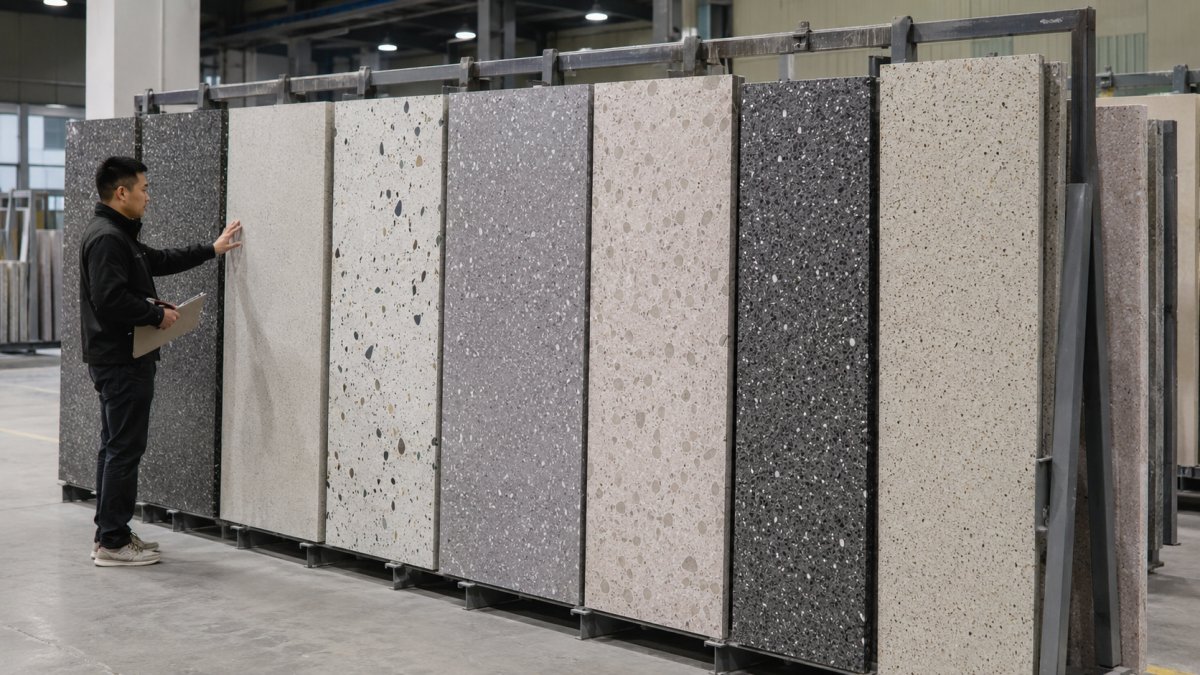
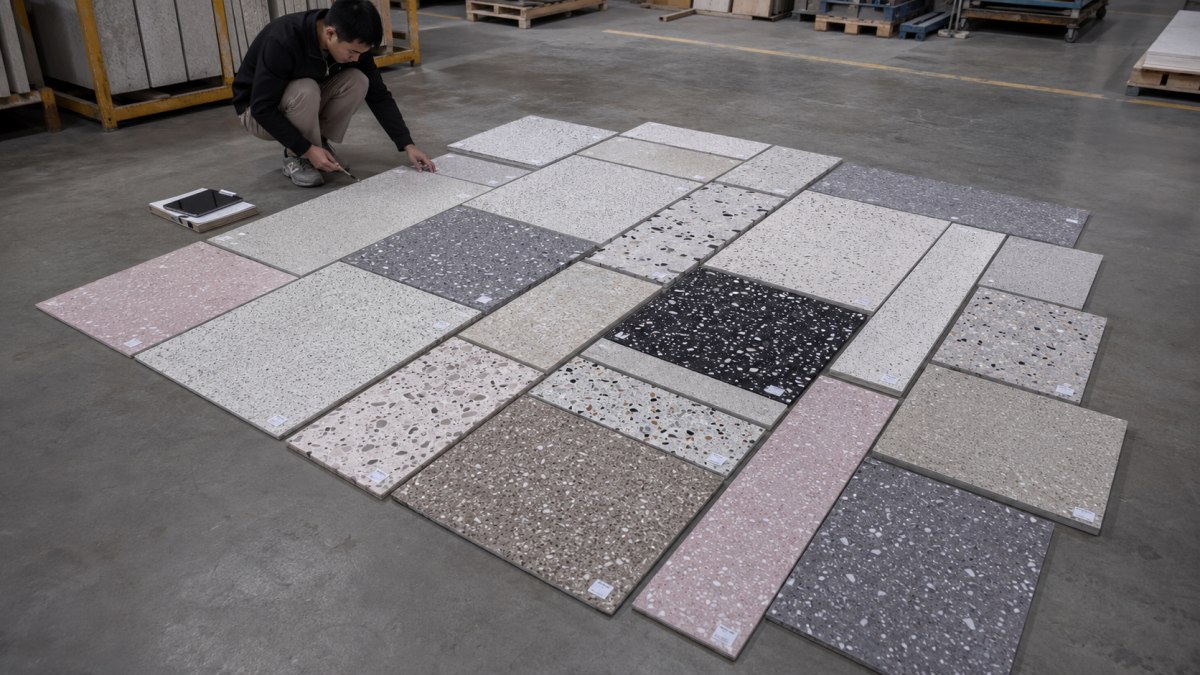
For cut-to-size projects, dry lay photos or layout photos may also help confirm piece numbering, direction, color range, and overall appearance before packing.
Set Written Approval Standards
Sample approval should not rely only on verbal messages such as “OK,” “approved,” or “looks good.”
A clear approval record should include:
· Sample code or reference number
· Date of approval
· Terrazzo type
· Matrix color
· Chip size and chip color
· Surface finish
· Thickness reference
· Intended application
· Acceptable variation range
· Whether full slab photos are required
· Whether production mockup is required
· Person or team responsible for approval
Written approval protects both sides. It helps the buyer define expectations, and it helps the supplier understand what should be controlled in production.
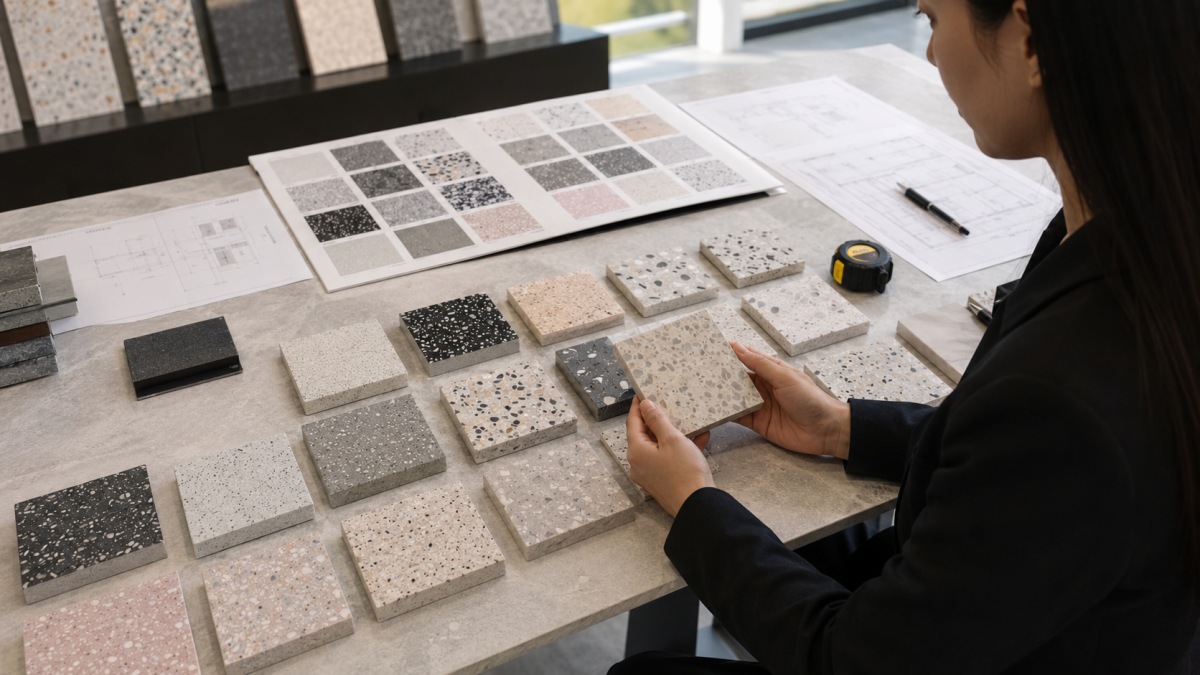
If the sample is only a design reference, say so clearly. If the sample is the strict production standard, that should also be written.
Clarify What Happens If the Sample Is Modified
Sometimes buyers approve a sample but later request changes, such as:
· Slightly warmer matrix color
· Smaller chips
· More chips
· Fewer chips
· Different finish
· Lower gloss
· Larger aggregate
· Custom color adjustment
· Different thickness
Every change should be treated as a new confirmation step. A modified sample should not move directly into mass production unless the buyer understands what has changed.
If the terrazzo design is adjusted, buyers should ask whether a new sample is needed before production.
Terrazzo Sample Review Checklist Before Mass Production
Use this checklist before approving terrazzo samples for production.
|
Review Item |
Buyer Should Confirm |
|
Terrazzo type |
Is it cement terrazzo, resin terrazzo, inorganic terrazzo, precast slab, tile, or cut-to-size? |
|
Application |
Will it be used for flooring, wall panels, countertops, stairs, wet areas, or commercial interiors? |
|
Matrix color |
Does the background color match the project design direction? |
|
Chip color |
Are the aggregate colors suitable for the intended space? |
|
Chip size |
Are the chips small, medium, large, or mixed? |
|
Chip density |
Is the distribution too sparse, too dense, or acceptable? |
|
Surface finish |
Is the finish polished, honed, matte, brushed, or textured? |
|
Lighting review |
Has the sample been checked under realistic lighting conditions? |
|
Thickness |
Does the sample thickness match the final order, or is it only a visual reference? |
|
Edge expectation |
Are exposed edges, nosing, or profiles relevant to the project? |
|
Full slab photos |
Are full slab photos needed before mass production? |
|
Variation range |
Has acceptable variation been discussed in writing? |
|
Drawings |
Are drawings needed for cut-to-size, stairs, panels, or countertops? |
|
Approval record |
Is the approval written, dated, and connected to the correct sample? |
|
Responsibility |
Who gives final approval before mass production starts? |
Red Flags Before Approving Terrazzo Samples
Buyers should slow down and recheck the approval if any of these signs appear:
· The sample is approved only by photo without physical review when physical approval is important.
· The application area has not been shared with the supplier.
· The sample size is too small for a large-area project.
· Chip size is approved, but full slab distribution is not reviewed.
· Finish is not confirmed in writing.
· The sample thickness does not match the final order.
· The buyer expects every slab to look identical to a small sample.
· The acceptable variation range is not discussed.
· The delivery schedule is confirmed before sample approval is clear.
· The project needs cut-to-size fabrication, but drawings are not ready.
· No one is clearly responsible for final sample approval.
A slow sample approval process is usually cheaper than a fast approval followed by production disputes.
FAQ
Is a small terrazzo sample enough before mass production?
A small sample is useful for confirming general color direction, chip style, and surface finish. However, it cannot fully represent full slab chip distribution, large-area visual effect, batch variation, or installed appearance. For large or design-sensitive projects, buyers should consider requesting full slab photos, larger samples, mockups, or dry lay photos.
What should buyers check in a terrazzo sample?
Buyers should check matrix color, chip color, chip size, chip density, surface finish, thickness reference, application suitability, lighting effect, acceptable variation, and whether the sample can be used as a production standard.
Can terrazzo samples fully represent full slabs?
No. A sample can guide design approval, but it cannot fully show full slab distribution, large-area rhythm, or how multiple slabs will look together. Terrazzo contains visible aggregates, so full-slab review may be important for large projects.
Should buyers approve terrazzo samples by photo only?
Photo approval may be acceptable for some early-stage reviews, but it is not always enough for final production approval. Screen color, lighting, camera angle, and image processing can affect what the buyer sees. For important projects, physical samples or full slab photos are safer.
Why does chip size matter in terrazzo sample approval?
Chip size affects the overall visual character. Small chips often create a more uniform appearance, while large chips create stronger movement and a more decorative surface. The buyer should confirm whether the chip size fits the project scale and design intent.
When should buyers request full slab photos before production?
Buyers should request full slab photos when the project uses large visible areas, large chips, custom colors, multiple slabs, high-visibility wall panels, hotel lobbies, commercial floors, or any design-sensitive application where full-scale appearance matters.
Should sample approval be confirmed in writing?
Yes. Written approval helps define the production standard and reduces later misunderstanding. The record should include sample reference, color, finish, chip size, thickness reference, application, approval date, and responsible approval person.
Before approving terrazzo samples for mass production, prepare the project application, expected finish, chip size preference, color direction, slab or cut-to-size requirement, thickness, drawings if needed, and acceptable variation range. These details help clarify whether the sample can serve as a realistic production reference before the order moves forward.



 IPv6 SUPORTADO POR REDE